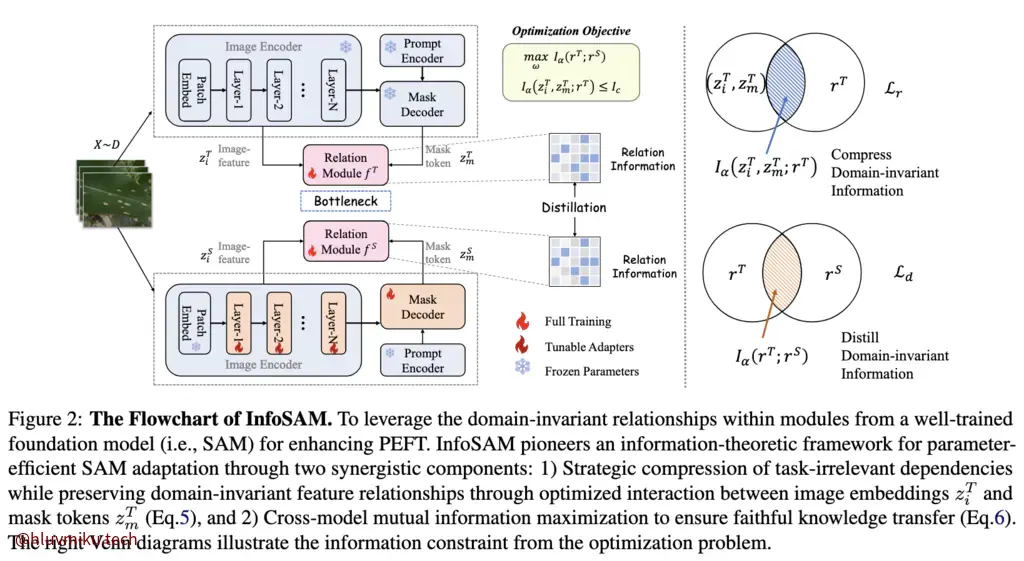
这篇文章设计的结构很简单,亮点在于loss设计以及可解释性上。
概要
However, existing PEFT methods for SAM neglect the domain-invariant relations encoded in the pretrained model.
文章认为,现有的PEFT后训练微调会忽视一些模型内嵌的领域不变关系,直接训练可能造成冗余或者破坏现有内在关系。于是本文从信息论角度来进行蒸馏+微调,通过巧妙设计Loss和Relation Module设计让模型学到领域不变关系。
Introduction
We argue that this is because task-specific tuning tends to override or suppress the universal visual features learned during pre-training.
直接进行特定任务的微调会导致原有的视觉特征被覆盖或者抑制。
为了更有效的进行PEFT,文章着重于解决以下两点:
- How can we extract the domain-invariant relationship from pretrained foundation models?
- How can we effectively transfer the extracted information to fine-tuned models?
对于问题1,文章设计了一个Relation module从Pretrained SAM来提取关键pattern,通过最小化Image Encoder、Mask Decoder与Relation Module的互信息来有效提取领域不变关系。简单来说,Relation Module 不应该记住 task-specific feature,而应该聚焦于稳定、低熵、可复用的关系结构。而对于问题2,文章巧妙设计了一个蒸馏结构,同时最大化Teacher和Student的互信息以有效transfer提取到的信息。在这里,文章主要用到了 Re ́nyi’s entropy-based quantification from information theory。
Renyi-alpha Entropy
Re ́nyi’s entropy定义如下:
其中
是归一化后的核矩阵。
在文中,我们采用了Renyi-2 Entropy,这时,我们可以简单地使用 ||\mathbf{A}||F^2来替换 \Sigma{i=1}^n\lambda_i^2(\mathbf{A})。对于核函数,文章采用了最简单的线性核:直接转置点积的方法。这个Renyi-alpha Entropy可以用来衡量“不变与变化”。
Methodology
Compressing Intra-SAM Relations
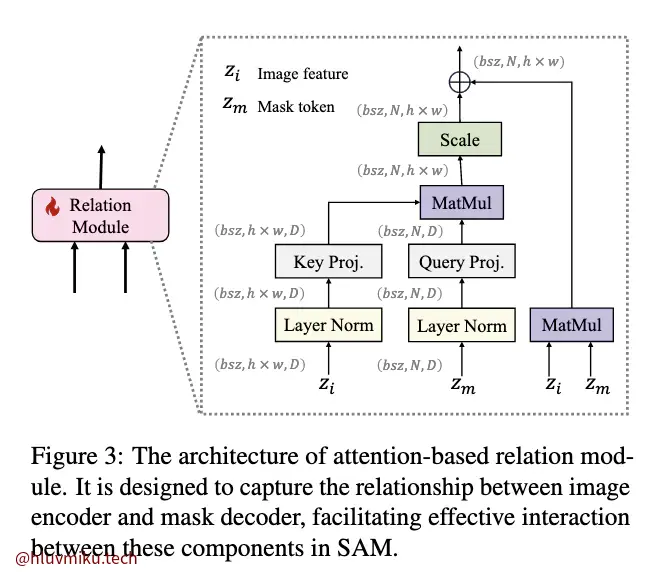
Relation Module设计很简单,是一个类似Attn的结构。真正巧妙之处在于它设计的loss:
简要来说前面一项从信息论视角看是正则项,用于约束关系模块,希望其能囊阔尽可能多的信息。第二项则希望ImageEncoder、MaskDecoder、RelationModule之间的互信息尽可能的小。这样,relation module就被迫被学会了最重要的不便特征。注意到这个Loss是对Teacher而言的,而Teacher中只有RelationModule可被训练,这就迫使RelationModule提取**“不变特征”**。
Maximizing Inter-SAM Relations
接下来我们来看看蒸馏。
While most existing works (Ahn et al., 2019; Kuang et al., 2023) focus on minimizing a lower bound of mutual information, we directly maximize the matrix-based R ́enyi’s mutual information itself to avoid the expensive evaluation of underlying distribution for distillation loss.
简要来说,本文直接最大化两个特征模块提取结果的互信息,而不是优化互信息的下界。做法也很简单:
最后将这俩loss再加上一个CElos作为最终的loss。
实现细节
在阅读论文时,我有几个疑惑:student的RelationModule是如何训练的,核函数是如何选择的?作者提供的伪代码都给了解答:student和teacher共用一个RelationModule,用的是最简单的线性核
# F_t, F_s: Pre-trained SAM (teacher) and fine-tuned SAM (student)# z_t_i, z_s_i: The output of the teacher and student image encoders# z_t_m, z_s_m: The output tokens in mask decoder of the teacher and student# f_t, f_s: Teacher and student relation modules# y_t, y_s: Teacher and student outputs# y: Ground-truth labels# Frob: Function for computing the square of the Frobenius norm
for x, y in loader:    # Forward pass    z_t_i, z_t_m, y_t = F_t(x)    z_s_i, z_s_m, y_s = F_s(x)
    # Compute structure loss    loss_ce = struct_loss(y_s, y)
    # Compute relations between image encoder and mask decoder    f_s = f_t    r_t = f_t(z_t_i, z_t_m)    r_s = f_t(z_s_i, z_s_m)
    # Normalize the representations    z_t_i_norm = F.normalize(z_t_i, p=2)    z_t_m_norm = F.normalize(z_t_m, p=2)
    # Compute normalized Gram matrices for compression loss_r    G_t_i = matmul(z_t_i_norm, z_t_i_norm.T)    G_t_m = matmul(z_t_m_norm, z_t_m_norm.T)    G_t_f = matmul(r_t, r_t.T)    G_t_f_norm = G_t_f / trace(G_t_f)    G_t_imr_norm = G_t_i * G_t_m * G_t_f / trace(G_t_i * G_t_m * G_t_f)
    # Compute normalized Gram matrices for distillation loss_d    G_s_f = matmul(r_s, r_s.T)    G_s_f_norm = G_s_f / trace(G_s_f)    G_ts_f_norm = G_s_f * G_t_f / trace(G_s_f * G_t_f)
    # Compute relation compression loss_r and distillation loss_d    loss_r = - log2(Frob(G_t_f_norm)) + log2(Frob(G_t_imr_norm))    loss_d = log2(Frob(G_t_f_norm)) + log2(Frob(G_s_f_norm)) - log2(Frob(G_ts_f_norm))    loss_info = lamda_1 * loss_r + lamda_2 * loss_d
    # The overall loss    loss = loss_ce + loss_info
    # Optimization step    loss.backward()    optimizer.step()
总结
这篇文章看得我汗流浃背——学了一学期的信息论感觉完全白学了。由于是简读,核函数、Ahn et al., 2019;、Kuang et al., 2023还有些其他的东西都没详细展开,相关论文也没咋读。但这篇文章确实非常精彩,无论是从工程角度还是学术角度。